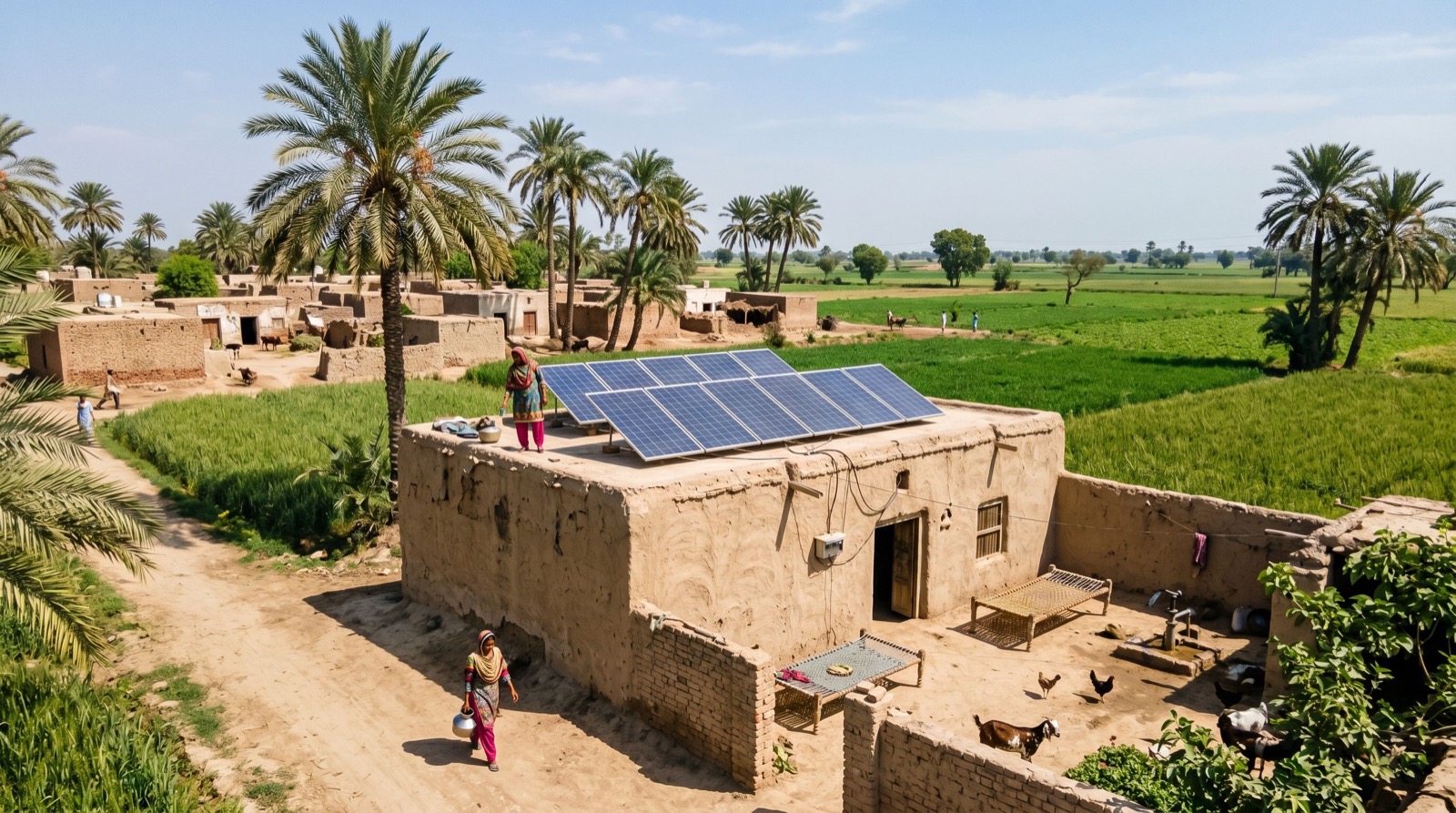
Electricity now eats a frightening share of household budgets, and every summer the slab tariffs bite a little harder. Net metering in Pakistan offers a legal, well-tested way to fight back: your rooftop generates power, the surplus flows into the grid, and your distribution company credits you for it. In 2026 the scheme remains active across all major DISCOs, though the rules have evolved and the smart approach has changed with them.
Below is a plain-language walkthrough of how the mechanism works, the exact application steps, and the savings a typical household can realistically expect this year.
How Net Metering in Pakistan Works in 2026
A bidirectional meter replaces your ordinary meter and records energy flowing in both directions. Units you import from the grid are billed at your normal tariff, while units you export earn credit at the approved buyback rate. At the end of each billing cycle the two figures are settled against one another, and any surplus credit rolls forward.
Pakistan is unusually well suited to this model. A World Bank study estimated that covering just 0.071 percent of the country’s land with solar panels could meet the nation’s entire electricity demand. Your roof is a small but genuinely profitable piece of that potential.
The 7 Steps From Application to Approval
- Pick a registered installer. Only systems installed by a certified solar company in Pakistan qualify for a net metering licence, so verify AEDB certification before paying any deposit.
- Get a proper load assessment. The installer studies twelve months of your bills and sizes the array accordingly, usually between 5 kW and 25 kW for homes.
- Upgrade to three phase if needed. Single-phase connections must be converted first, a job your DISCO performs for a fee within a few weeks.
- Install the system. Panels, inverter, earthing, and protection gear go in, typically over two to four working days.
- Submit the application. Technical drawings, your CNIC, ownership documents, and the inverter’s certification all go to the DISCO together.
- Pass the site inspection. DISCO engineers verify that the physical installation matches the drawings and meets safety codes.
- Sign the agreement and receive the meter. Once the bidirectional meter is energised, your exports start earning credit from day one.
The full journey usually takes six to ten weeks depending on your DISCO’s backlog, so begin the paperwork alongside the installation rather than after it. Every week of delay is another full-price bill.
What the Connection Actually Costs
Beyond the solar hardware itself, budget for the regulatory side of the journey. The charges vary a little between distribution companies, but the pattern is consistent across Punjab, Sindh, and KP in 2026:
- Bidirectional green meter and its installation, usually Rs 50,000 to Rs 75,000.
- Licence processing and inspection fees, typically Rs 15,000 to Rs 25,000.
- Three-phase conversion where required, often Rs 35,000 to Rs 60,000 depending on your distance from the transformer.
- Load extension charges if your sanctioned load must rise to match the new system.
Taken together, the regulatory side rarely exceeds ten percent of the project cost, yet it is the part that unlocks every rupee of export credit afterwards. Ask each bidder to state these charges separately in the proposal so nothing surfaces as a surprise at commissioning.
How Much Can You Actually Save Each Month?
Savings depend on system size, how much of the output you consume yourself, and which tariff slab you have been living in. The table shows three representative households in 2026:
| Household | System | Old average bill | New average bill | Yearly saving |
|---|---|---|---|---|
| Three-bed home, Lahore | 6 kW | Rs 38,000 | Rs 4,500 | Rs 402,000 |
| Joint family, Gujranwala | 10 kW | Rs 61,000 | Rs 7,000 | Rs 648,000 |
| Home office, Karachi | 8 kW | Rs 47,000 | Rs 5,500 | Rs 498,000 |
The middle row is no accident. Manufacturing households there run freezers, motors, and small workshops off the same domestic connection, so bills climb brutally fast. Demand for solar panels in Gujranwala has surged for precisely this reason: heavy daytime loads pair perfectly with rooftop generation, because every self-consumed unit is worth the full retail tariff.
One honest caveat belongs here. The 2026 buyback rate for exported units is lower than the old one-to-one settlement, so the game has shifted. Design your system so that most of its output is consumed during daylight hours, and treat exported units as a pleasant bonus rather than the main event.
Timing your usage helps more than any gadget. Run the washing machine, iron, and water pump between ten in the morning and three in the afternoon, and you convert cheap sunshine directly into avoided slab charges. Families that shift even a third of their load into daylight hours consistently beat the projections their installers quoted them.
Mistakes That Slow Down or Sink Applications
- Buying a non-certified inverter that the DISCO refuses to approve at inspection.
- Submitting a bill still registered in a deceased relative’s name without transfer papers.
- Requesting capacity beyond your sanctioned load, which triggers an automatic objection.
- Skipping the earthing test report, the single most common inspection failure.
- Chasing the lowest quote from firms that vanish once the commissioning payment clears.
Money decisions reward the same habits everywhere. Just as beginners sorting out their finances do better when they lean on reliable local experts instead of guesswork, a smooth approval usually comes down to choosing people who have already filed dozens of successful applications with your specific DISCO and know its quirks by heart.
Frequently Asked Questions
Is net metering still open to new applicants in 2026?
Yes. Policy debates continue in the news, but all major distribution companies are accepting and approving new applications in 2026. Systems approved under an existing agreement keep their terms for the full contract period.
What is the smallest system that qualifies?
The framework technically covers systems from 1 kW up to 1 MW. In practice most installers recommend at least 5 kW so that the licence fees, meter cost, and three-phase upgrade are recovered quickly from savings.
Do I lose my credits if I move house?
The agreement attaches to the meter and the premises rather than to you personally. If you sell the property, the licence transfers to the new owner with the DISCO’s consent, which usually adds value to the sale.
Your Next Move
Net metering in Pakistan remains one of the very few investments that pays a household back every single month, in a currency that keeps losing ground against electricity tariffs. Pull out your last twelve bills tonight, request two or three written proposals, and confirm your installer’s certification before signing anything. The sooner your meter starts counting in both directions, the sooner the grid starts working for you instead of against you.