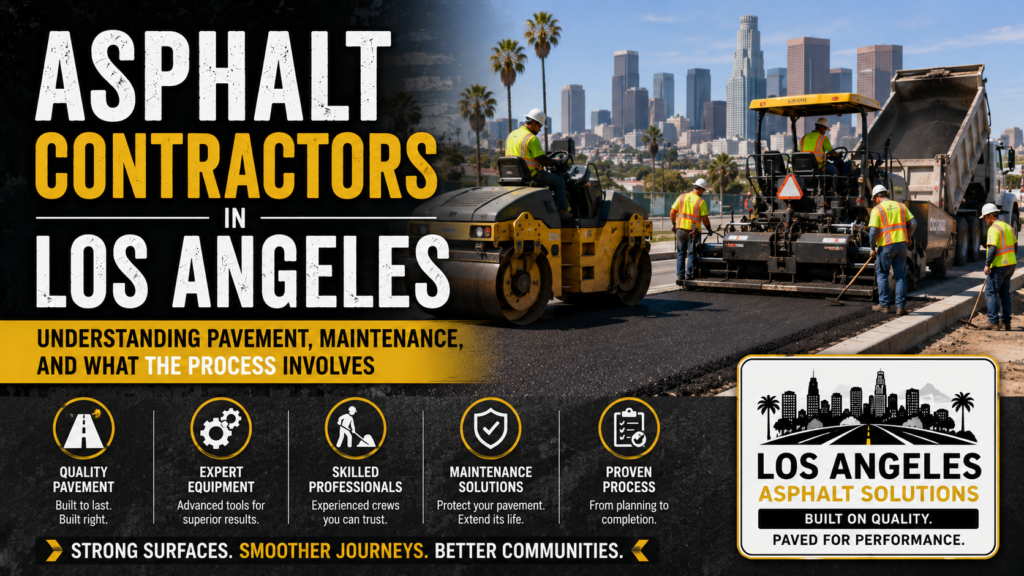
Los Angeles is defined by its roads. With one of the largest networks of streets, driveways, parking lots, and commercial surfaces in the United States, the pavement infrastructure of LA is both vast and constantly in need of maintenance, repair, and renewal. From the residential neighborhoods of the Westside to the sprawling commercial corridors of the San Fernando Valley, asphalt is the surface on which daily life in Los Angeles moves.
For property owners, facility managers, business operators, and homeowners across Los Angeles, understanding what Asphalt Contractor Los Angeles do and how the various types of asphalt work and maintenance function is practically useful knowledge. Whether you manage a parking lot, own a home with a driveway, or oversee a commercial property, this guide covers the essentials of asphalt paving and maintenance in the context of Los Angeles’s unique climate and urban environment.
What Is Asphalt and Why Is It Used?
Asphalt, also called blacktop or bituminous concrete, is a composite paving material made primarily from aggregates crushed stone, gravel, and sand bound together with bitumen, a petroleum-derived black, viscous binding agent. The resulting material is flexible, durable, weather-resistant, and highly versatile, making it the most widely used paving material in the United States.
Approximately 94 percent of all paved roads and parking areas in the United States are surfaced with asphalt. The reasons for this dominance are practical: asphalt is generally less expensive to install than concrete, can be laid and opened to traffic relatively quickly, is quieter under vehicle traffic due to its sound-absorbing surface characteristics, and is highly recyclable asphalt pavement is among the most recycled materials in the country, with reclaimed asphalt pavement (RAP) commonly incorporated into new mixes.
Asphalt is also well-suited to the seismic reality of Los Angeles. Unlike rigid concrete, asphalt has a degree of flexibility that allows it to accommodate minor ground movement and thermal expansion and contraction without the cracking and joint failures that rigid pavement systems can develop.
How Los Angeles’s Climate Affects Asphalt
Southern California’s Mediterranean climate characterized by hot, dry summers, mild winters, and intense UV radiation year-round creates specific challenges for asphalt pavement that differ significantly from those faced by pavement in more temperate or wetter climates.
UV Oxidation: Los Angeles receives an average of over 280 sunny days per year. Constant UV radiation accelerates the oxidation of asphalt binders the chemical process by which the bitumen progressively loses its flexibility and binding properties. Over time, oxidized asphalt turns from deep black to a faded gray color and becomes increasingly brittle and prone to cracking. Research from UCLA Civil Engineering has found that asphalt in LA’s high-UV environment loses significantly more flexibility annually than asphalt in cooler, less sunny climates.
Thermal Stress: LA’s pavement surfaces can reach temperatures exceeding 140°F during summer months. This extreme surface heat softens the asphalt binders, and the resulting expansion and contraction cycle as the pavement heats and cools causes microcracks to develop over time.
Rainfall and Water Infiltration: While LA is relatively dry, the wet season brings rainfall that can infiltrate existing cracks in asphalt surfaces and weaken the underlying base layers. Water that enters the pavement structure and becomes trapped can accelerate deterioration significantly, particularly when the base material becomes saturated.
High Traffic Loads: Los Angeles supports some of the highest vehicle density in the nation. The combination of passenger vehicle traffic, commercial trucks, and heavy delivery vehicles places continuous stress on road and parking surfaces, accelerating wear and the development of ruts, cracks, and potholes.
Types of Asphalt Work: From New Installation to Maintenance
The scope of work performed by asphalt contractors in Los Angeles spans a broad range, from full installation of new pavement to targeted maintenance of existing surfaces.
New Asphalt Installation: New pavement installation begins with site preparation grading and compacting the underlying subgrade to create a stable, properly sloped base. Proper drainage design is incorporated at this stage, as water management is critical to long-term pavement performance. A compacted gravel base course is then installed above the subgrade, providing structural support and further drainage. Hot mix asphalt is then delivered from the plant and laid using specialized paving equipment. The fresh asphalt is then compacted using heavy rollers to achieve the density required for structural performance. For residential driveways, the process is the same in principle but scaled appropriately.
Asphalt Resurfacing / Overlay: When an existing pavement surface has deteriorated but the underlying base is still structurally sound, resurfacing also called overlaying is a cost-effective alternative to full replacement. A thin new layer of hot mix asphalt is applied over the existing surface after preparation, renewing the driving surface and protecting the underlying structure. Resurfacing extends pavement life significantly at a fraction of the cost of full replacement.
Crack Sealing: Cracks in asphalt allow water to penetrate the pavement structure, accelerating deterioration. Crack sealing is the process of cleaning cracks and filling them with a flexible rubberized sealant that adheres to the asphalt edges and prevents water and debris from entering. It is most effective when performed early in a crack’s life cycle before moisture has had time to weaken the base. For Los Angeles pavement, where UV oxidation makes cracking inevitable over time, routine crack sealing is one of the most cost-effective maintenance investments a property owner can make.
Pothole Repair: Potholes form when water infiltration, base failure, and traffic stress combine to cause the pavement surface to collapse. They range from nuisances to genuine safety hazards. Patching methods vary from throw-and-roll temporary repairs to semi-permanent patches and full-depth replacements depending on the severity and cause of the pothole. A permanent pothole repair addresses not just the surface but the base failure that caused it.
Sealcoating: Sealcoating is the application of a liquid asphalt-based emulsion to the surface of existing pavement. It seals fine surface voids, protects against UV oxidation, resists oil and chemical penetration, improves water runoff, and restores the dark appearance of the asphalt. In California’s mild climate, sealcoating is typically recommended 12 to 24 months after new asphalt installation, and then every two to three years thereafter depending on traffic and sun exposure.
Parking Lot Striping: Parking lot marking the painted lines, arrows, ADA-compliant stall designations, fire lane markings, and other surface markings is often performed by asphalt contractors in conjunction with paving or sealcoating work. Crisp, visible striping is both a safety requirement and a legal obligation for commercial properties subject to ADA compliance.
The Asphalt Installation Process
Understanding what actually happens during an asphalt installation project helps property owners know what to expect and why each step matters.
Site Assessment: A qualified asphalt contractor begins with an on-site evaluation of the existing conditions soil type, drainage patterns, current pavement condition, traffic load expectations, and any relevant code requirements. This assessment informs the design of the pavement system, including the appropriate asphalt mix, thickness, and base depth.
Subgrade Preparation: The strength and longevity of asphalt pavement begins with the ground beneath it. The subgrade must be properly graded, free of organic material, and compacted to the density specified for the project. Soft spots or poorly compacted areas will result in premature failure regardless of the quality of the asphalt above them.
Base Installation: A compacted aggregate base is installed above the subgrade. The base provides structural support, distributes loads, and facilitates drainage. Its depth is engineered based on expected traffic loads and soil conditions.
Asphalt Mixing and Delivery: Hot mix asphalt (HMA) is produced at an asphalt plant where aggregate and bitumen are heated and combined at temperatures between 275°F and 325°F. The mix must be transported to the site and placed while it remains within the workable temperature range time from plant to placement is a critical quality factor.
Paving: A self-propelled paving machine the asphalt paver receives the hot mix and spreads it evenly at the specified thickness and grade. The screed at the rear of the paver provides initial compaction and surface smoothing.
Compaction: Immediately following placement, heavy steel-drum and pneumatic-tire rollers compact the asphalt to achieve the specified density. Proper compaction is one of the most important factors in pavement durability inadequately compacted asphalt is permeable to water and prone to early deterioration.
Curing and Opening: While asphalt cools relatively quickly and can typically be opened to light traffic within hours of placement, full curing during which the bitumen hardens to its final state occurs over several months.
Signs Your Los Angeles Pavement Needs Attention
The visible condition of asphalt pavement provides clear signals about its health and the type of maintenance it needs. Recognizing these signals early allows property owners to address issues before they become significantly more expensive.
Color Change (Gray Fading): Healthy asphalt is dark black. As UV oxidation progresses, asphalt fades to gray. Gray coloration indicates that the surface binders are depleting and the pavement is becoming increasingly brittle. This is the ideal time for sealcoating before cracking begins.
Surface Cracking: Fine surface cracks, edge cracks, block cracking (a grid pattern of cracks across the surface), and longitudinal cracks along the pavement’s length all indicate progressive deterioration. Early-stage cracking responds well to crack sealing. More extensive cracking may indicate base failure and require more substantial intervention.
Alligator Cracking: A network of interconnected cracks resembling alligator skin indicates structural failure of the base typically caused by water infiltration, inadequate base depth, or traffic loads exceeding the pavement’s design capacity. Alligator cracking cannot be resolved with sealcoating or surface crack filling; it requires excavation and reconstruction of the affected area.
Potholes and Depressions: Potholes and surface depressions indicate advanced deterioration. Potholes require patching or full-depth repair. Surface depressions can indicate base settlement or rutting from heavy traffic.
For Los Angeles property owners and managers, a general rule of thumb is to inspect paved surfaces seasonally and to act on signs of deterioration early. The cost of proactive maintenance is consistently a fraction of the cost of deferred repair.
Asphalt and Sustainability in Los Angeles
Los Angeles is at the forefront of urban sustainability initiatives, and the city’s approach to pavement management increasingly incorporates environmentally conscious practices.
Recycled Asphalt: Asphalt is the most recycled material in the United States. When old pavement is milled or removed, the reclaimed asphalt pavement (RAP) can be processed and incorporated into new asphalt mixes at rates of 20 to 30 percent or more, reducing the need for virgin aggregate and bitumen and diverting material from landfills.
Cool Pavement Programs: Los Angeles has been a leader in cool pavement initiatives the application of light-colored coatings to asphalt surfaces to reduce heat absorption and the urban heat island effect. These treatments can reduce surface temperatures by 10 to 20°F, contributing to lower ambient temperatures in dense urban areas.
Permeable Asphalt: Porous or permeable asphalt an open-graded mix that allows water to pass through the surface into a prepared gravel base is used in certain applications to manage stormwater on-site, reducing runoff and contributing to groundwater recharge. This technology is particularly relevant in LA as the city works to manage stormwater as a resource rather than waste.